
SUPPORTING SCHOOL TRANSFORMATION
Practical Support for School Leaders
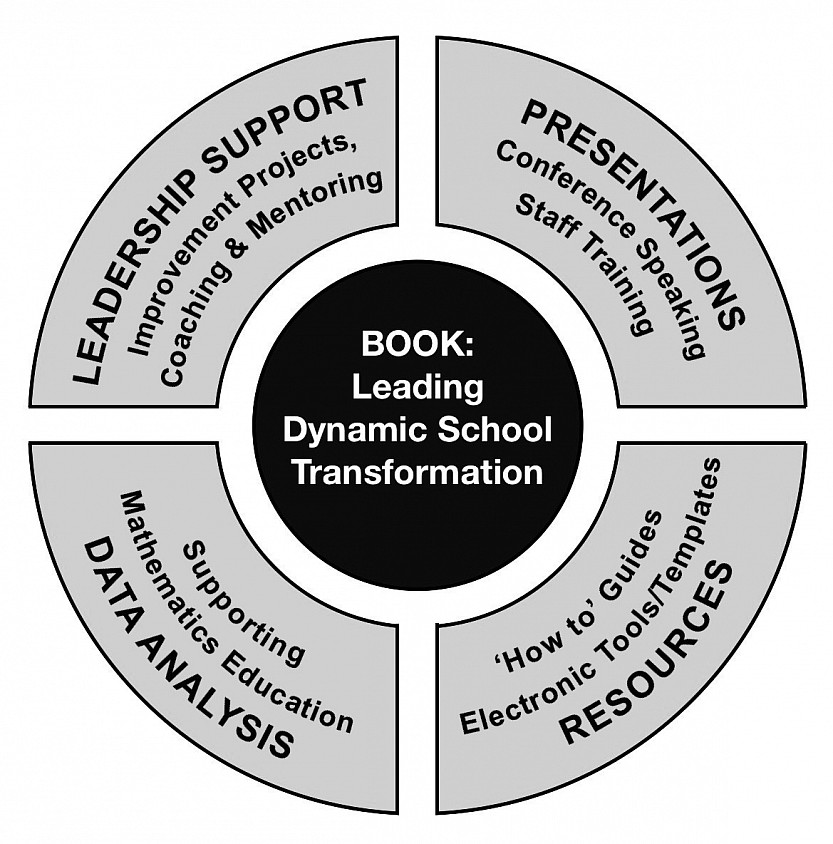
School Support Options
We provide support to schools in a number of ways that focus on implementing specific elements of the Dynamic School Transformation Framework and the associated tools provided to support its implementation.
A Comprehensive Programme
Over a number of years we have developed a rigorous, research-driven model for continuous and sustained improvement in schools that has resulted in the development of a comprehensive handbook for school leaders that provides guidance and associated tools that cover the full range of school leadership strategies,
The major advantage of having such a handbook is that we can provide instant solutions to most of the challenges that schools experience. Consequently, in addition to purchasing the handbook we can provide the following support for schools, universities and other training providers:
- Training and coaching to support the implementation of all, or constituent parts of, the School Transformation Framework.
- Support with evaluating the school context (Phase I).
- Support with school improvement planning and implementation (Phase 2).
- Individual or school support with leadership development and extending leadership capacity.
- Provision of electronic tools and templates that are discussed in the handbook.
- Bespoke analysis of school data.
- Support with mathematics and statistics teaching.
We can provide a fully supported school improvement programme or schools can choose which aspects of the programme they wish us to provide.
Supported School Evaluation
The school evaluation services that we offer are very different from either OFSTED inspection or school self-evaluation in three crucial respects. Firstly, the work undertaken is very much done with the full and active participation of the school’s leaders. Secondly, it includes a strong and vital element of independent external validation of judgements. Thirdly, we focus on providing a detailed analysis of the school context, alongside which subsequent professional judgements are set, by employing a robust research methodology that involves gathering, statistically analysing and interpreting data and other evidence followed by an accurate evaluation and critical reflection of the existing situation. P
