
Discovering a Unified Approach to School Transformation
The Need for Change
There are a number of significant limitations and concerns within the school effectiveness and improvement research. These concerns have, in turn, impacted on subsequent formulations of the OFSTED framework and school performance measures. Irrespective of these findings, their legacy and impact on schools has been profound; constantly inhibiting successful school transformation efforts.
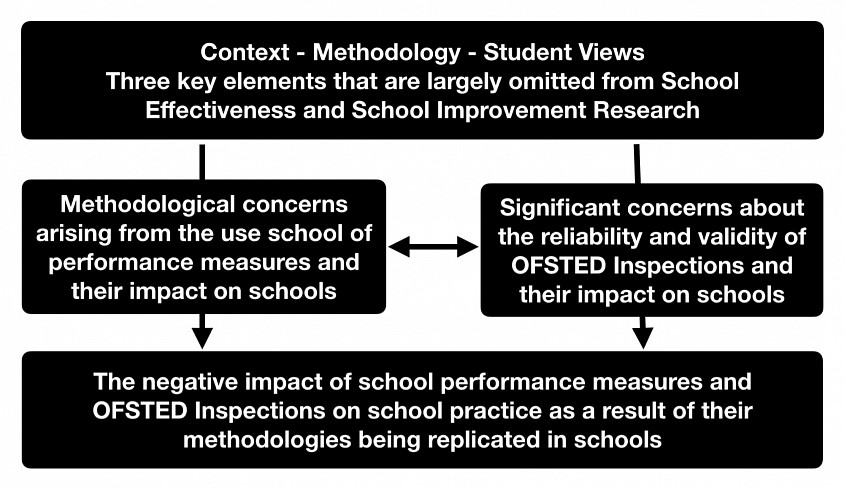
The four 'critical issues' set out above highlight the need for schools to do different things in different ways.
Six Crucial Questions
Our fresh approach to transforming schools over time is rooted in addressing six crucial questions. In some ways there is nothing new here - just a reframing of what we know works.

The Six Critical Questions
These questions have in turn informed the development of an innovative School Transformation Framework that transcends existing school effectiveness and school improvement approaches. Of course, successful implementation of the Transformation Framework is dependent on school leaders being aligned with its potential for success and being prepared to do things 'in the right way'.
The Framework
Our coherent School Transformation Framework comprises 6 key components and 9 associated leadership strategies and tools that are tightly bound together within the infinity diagram shown here.
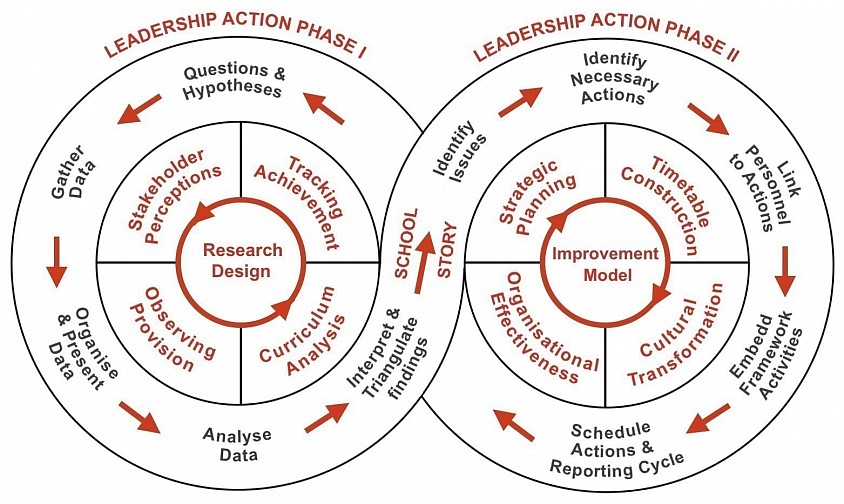
The Transformation Framework
The Framework Unpacked
Leadership Action Phase 1 is directed towards understanding how effective the school is at any point in time. This requires a forensic investigation of the school context using a combination of four research-based techniques:
- Strategy 1:
Analysing stakeholder perceptions.
- Strategy 2:
Tracking student progress.
- Strategy 3:
Observing the quality of provision.
- Strategy 4:
Analysing the curriculum & staff deployment.
The information and insight gained by leaders during Leadership Action Phase 1 is then statistically analysed to identify areas requiring improvement.
Leadership Action Phase 2 focuses on what leaders need to do to ensure that planned improvements are successfully implemented and their impact evaluated. Consequently, Phase 2 requires an understanding of ‘what works’ in improving schools and knowing how to plan for and tackle specific areas that require improvement quickly and effectively ‘on the ground’. At the core of this Phase II lies a statistically derived conceptual multilevel school improvement model and four strategic planning techniques:
- Strategy 5:
Action planning / management of resources.
- Strategy 6:
Curriculum design and timetable construction.
- Strategy 7:
Securing organisational effectiveness.
- Strategy 8:
Developing a positive school culture.
Strategy 9: The School Story sits at the crossover between Leadership Action Phases I and II and uses Data Storytelling techniques to provide a summary of the triangulated evidence gathered from all the activities and tools within the Transformation Framework.
The Outer Ring of Leadership Action Phase I requires school leaders to develop and then deploy higher level skills in gathering, analysing, and interpreting data. The use of rigorous statistical techniques is a critical aspect of speedily identifying the root causes of problems and what needs to be done to bring about rapid improvement.
The Outer Ring of Leadership Action Phase II sets out the steps that are necessary to ensure that the identified high-impact improvement strategies and their associated actions identified in Phase I are effectively implemented and monitored. To be effective, this involves re-focusing on those aspects of school leadership practice that are essential to ensuring that the School Transformation Framework is firmly embedded in the day-to-day work of the school and its leaders.
School transformation is a continuous, dynamic, and cyclical process in which the two Leadership Action Phases are seamlessly interconnected in a powerful way as part of an ongoing and perpetual approach to leadership action. This dynamic feature of the framework ensures that schools are led in a more responsive, context-sensitive, and sustainable way that reinforces the importance of continuous reflection, re-evaluation, and feedback. This in turn results in the perpetual re-shaping and refining of improvement strategies.
The six crucial components and the nine associated leadership strategies bring together research, informed educational action, and school leadership approaches under a coherent set of continuous and convergent processes that secure high-impact leadership embedded in the day-to-day actions and activities in the school.
