
ANALYSING DATA
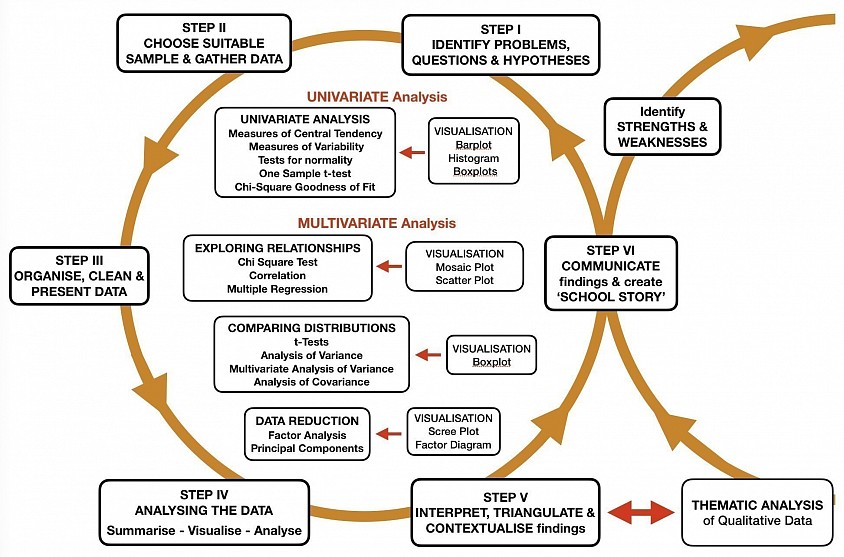
A Six-Step Approach
Our approach to analysing data draws together the crucial elements of data storytelling using a step-by-step approach that involves:
- Step I:
Posing the right questions and hypotheses.
- Step II:
Choose a sample and gather data.
- Step III:
Organise, clean, and present the data,
- Step IV:
Summarise, visualise and analyse the data.
- Step V:
Interpret the findings from the analysis.
- Step VI:
Communicate findings as part of School Story.
Questions are categorised into those requiring: a univariate analysis; exploration of relationships; comparison between distributions and data reduction. An aide-memoire is provided to outline the types of statistical tests required to answer questions typically asked by, and of, school leaders in each category. A sample dataset is introduced, which is used in later modules to provide model solutions and worked examples that employ extracts of R-code provided to assist those new to this approach. An introduction to the use of the statistical package R is provided.
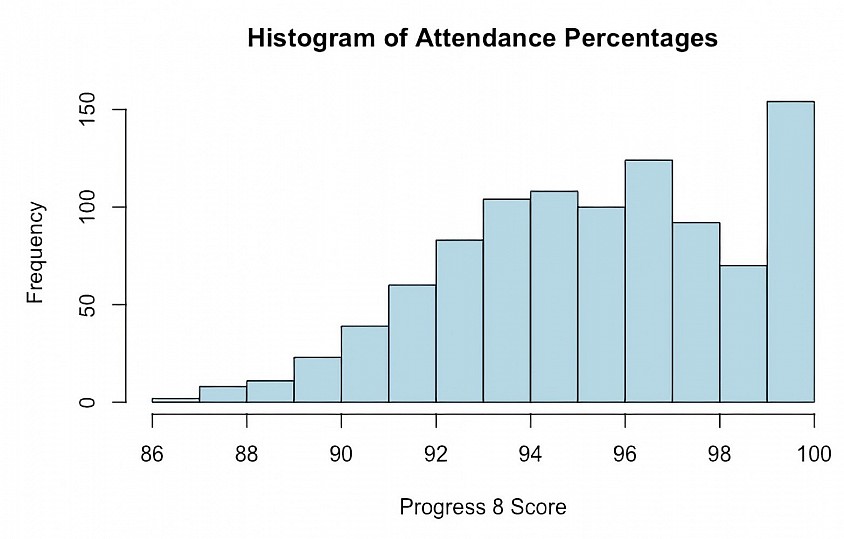
Essential R Techniques for School Leaders
Detailed guidance on analysing data using the well-known statistical package R, follows that provided in Chapter 11 of the book. The aim is to up-skill school leaders in the use of statistics through the use of worked examples and associated R-code.
The development of leaders’ understanding and use of the main statistical techniques used to analyse data are best presented in six sections:
- Visualising data using tables and charts;
- Conducting univariate tests;
- Exploring relationships using chi square, correlation and multiple regression;
- Using factor analysis to discover strengths and weaknesses;
- Comparing two or more measures using t-tests and Analysis of Variance;
- Analysing qualitative data.
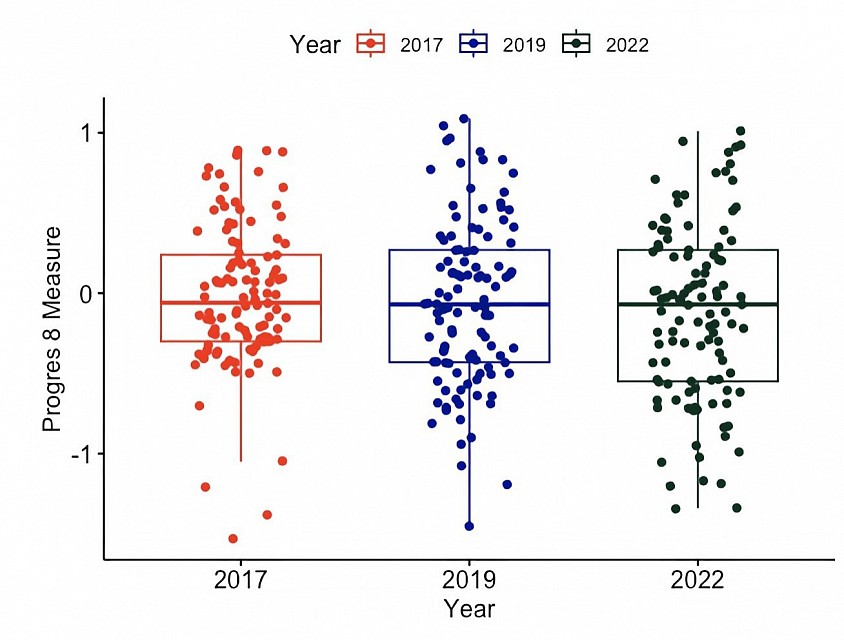
Or, we can Analyse Data for you
In addition to providing taught sessions on data analysis, we can be commissioned to gather, analyse and interpret school data using a wide range of multivariate statistical tests. We always adhere to BERA guidelines.
